
Monkey See Monkey Do
TMS@ your practice

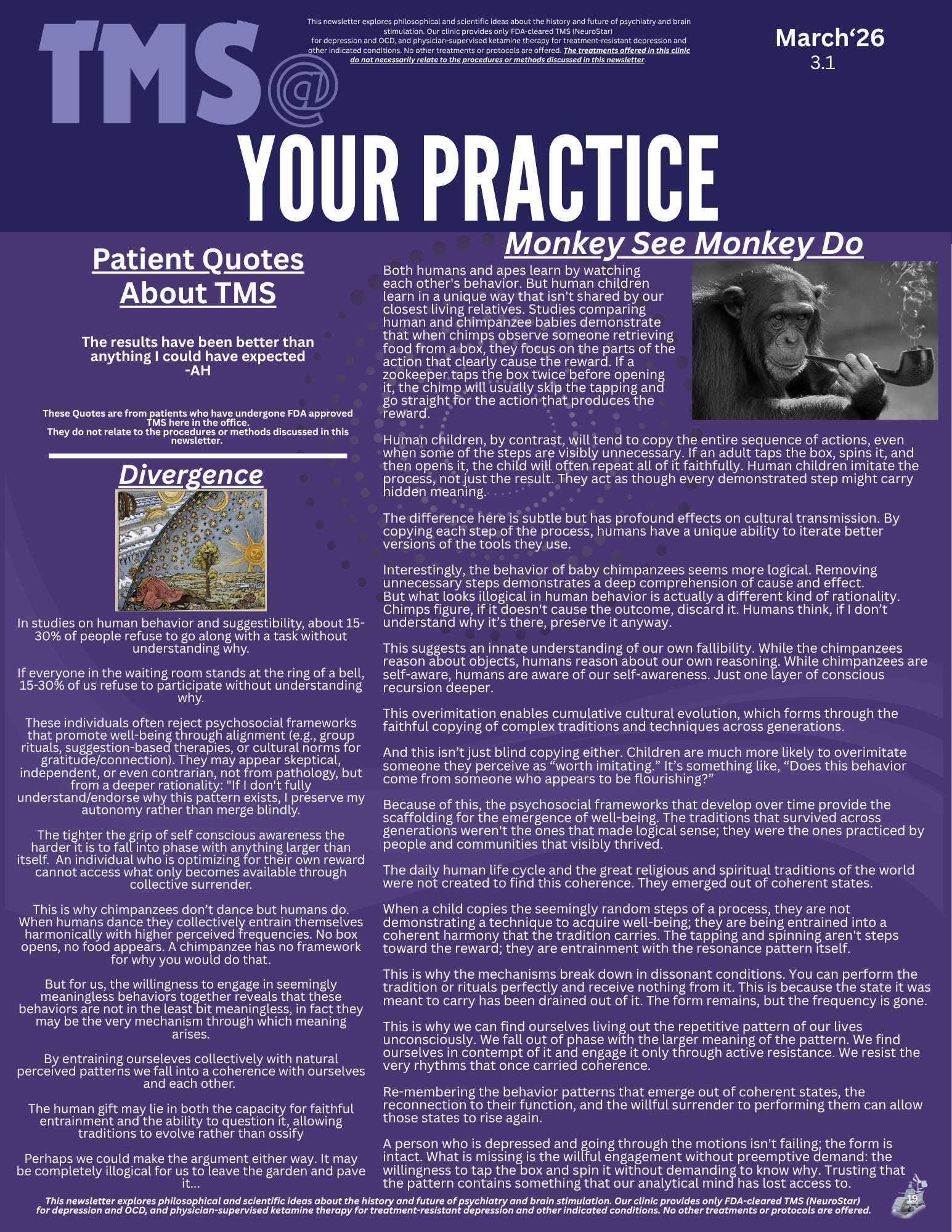
Monkey See Monkey Do
Both humans and apes learn by watching each other’s behavior. But human children learn in a unique way that isn’t shared by our closest living relatives. Studies comparing human and chimpanzee babies demonstrate that when chimps observe someone retrieving food from a box, they focus on the parts of the action that clearly cause the reward. If a zookeeper taps the box twice before opening it, the chimp will usually skip the tapping and go straight for the action that produces the reward.
Human children, by contrast, will tend to copy the entire sequence of actions, even when some of the steps are visibly unnecessary. If an adult taps the box, spins it, and then opens it, the child will often repeat all of it faithfully. Human children imitate the process, not just the result. They act as though every demonstrated step might carry hidden meaning.
The difference here is subtle but has profound effects on cultural transmission. By copying each step of the process, humans have a unique ability to iterate better versions of the tools they use.
Interestingly, the behavior of baby chimpanzees seems more logical. Removing unnecessary steps demonstrates a deep comprehension of cause and effect.
But what looks illogical in human behavior is actually a different kind of rationality. Chimps figure, if it doesn’t cause the outcome, discard it. Humans think, if I don’t understand why it’s there, preserve it anyway.
This suggests an innate understanding of our own fallibility. While the chimpanzees reason about objects, humans reason about our own reasoning. While chimpanzees are self-aware, humans are aware of our self-awareness. Just one layer of conscious recursion deeper.
This overimitation enables cumulative cultural evolution, which forms through the faithful copying of complex traditions and techniques across generations.
And this isn’t just blind copying either. Children are much more likely to overimitate someone they perceive as “worth imitating.” It’s something like, “Does this behavior come from someone who appears to be flourishing?”
Because of this, the psychosocial frameworks that develop over time provide the scaffolding for the emergence of well-being. The traditions that survived across generations weren’t the ones that made logical sense; they were the ones practiced by people and communities that visibly thrived.
The daily human life cycle and the great religious and spiritual traditions of the world were not created to find this coherence. They emerged out of coherent states.
When a child copies the seemingly random steps of a process, they are not demonstrating a technique to acquire well-being; they are being entrained into a coherent harmony that the tradition carries. The tapping and spinning aren’t steps toward the reward; they are entrainment with the resonance pattern itself.
This is why the mechanisms break down in dissonant conditions. You can perform the tradition or rituals perfectly and receive nothing from it. This is because the state it was meant to carry has been drained out of it. The form remains, but the frequency is gone.
This is why we can find ourselves living out the repetitive pattern of our lives unconsciously. We fall out of phase with the larger meaning of the pattern. We find ourselves in contempt of it and engage it only through active resistance. We resist the very rhythms that once carried coherence.
Re-membering the behavior patterns that emerge out of coherent states, the reconnection to their function, and the willful surrender to performing them can allow those states to rise again.
A person who is depressed and going through the motions isn’t failing; the form is intact. What is missing is the willful engagement without preemptive demand: the willingness to tap the box and spin it without demanding to know why. Trusting that the pattern contains something that our analytical mind has lost access to.
Divergence
In studies on human behavior and suggestibility, about 15-30% of people refuse to go along with a task without understanding why.
If everyone in the waiting room stands at the ring of a bell, 15-30% of us refuse to participate without understanding why.
These individuals often reject psychosocial frameworks that promote well-being through alignment (e.g., group rituals, suggestion-based therapies, or cultural norms for gratitude/connection). They may appear skeptical, independent, or even contrarian, not from pathology, but from a deeper rationality: “If I don’t fully understand/endorse why this pattern exists, I preserve my autonomy rather than merge blindly.”
The tighter the grip of self conscious awareness the harder it is to fall into phase with anything larger than itself. An individual who is optimizing for their own reward cannot access what only becomes available through collective surrender.
This is why chimpanzees don’t dance but humans do. When humans dance they collectively entrain themselves harmonically with higher perceived frequencies. No box opens, no food appears. A chimpanzee has no framework for why you would do that.
But for us, the willingness to engage in seemingly meaningless behaviors together reveals that these behaviors are not in the least bit meaningless, in fact they may be the very mechanism through which meaning arises.
By entraining ourselves collectively with natural perceived patterns we fall into a coherence with ourselves and each other.
The human gift may lie in both the capacity for faithful entrainment and the ability to question it, allowing traditions to evolve rather than ossify.
Perhaps we could make the argument either way. It may be completely illogical for us to leave the garden and pave it...