
Endogenous Ecstasis

Endogenous Ecstasis
Humanity is full of stories about attaining divine states. The fountain of youth, the holy grail, the philosophers stone and ambrosia all represented the ultimate attainment.
But the striving for these states through external means has created a peculiar problem.
When profound states of consciousness are induced through external means like psychedelics, sensory technologies, or brain stimulation, there’s a persistent tendency to dismiss the experiences as ‘artificial’ or ‘unreal.’
The reasoning goes: if a state is externally produced, the experiences within it don’t count. They’re artifacts of the method, not genuine encounters with consciousness itself.
But these same states, with identical phenomenology, identical neural signatures, identical reports of meaning and transcendence, arise spontaneously, without any external cause, sometimes as a symptom of human behaviors considered pathology.
It is widely known that some women have profound transcendent experiences when giving birth or post partum. We have all heard of the “runners high” or meditation induced visions. Sleep paralysis is a modern pathology known to create the phenomenon. Fasting or starvation states, near death experiences, and fever can all reliably create these ecstatic states.
Famously, astronauts returning from space describe a profound spiritual experience when viewing the world as one from above that they call “the overview effect” that leaves them radically changed.
Neuroscience has long known that temporal lobe seizure activity (TLE) has the potential to create spontaneous and endogenous ecstatic states, which they call “seizure with aura.” (TLE) is well-documented for producing auras with euphoria, déjà-vu, or religious-like experiences. For instance, studies (e.g., from the Journal of Neurology, Neurosurgery & Psychiatry) show that up to 10-20% of TLE patients report ecstatic auras, often linked to gamma-wave bursts or hippocampal overactivity.
During these states, patients report overwhelming sense of coherence and meaning, loss of subject-object boundaries, time distortion (eternal present), synesthesia, and ineffable knowledge that can’t be put into words. These experiences are often accompanied by involuntary movements, hand and body postures, and other autonomic behavior.
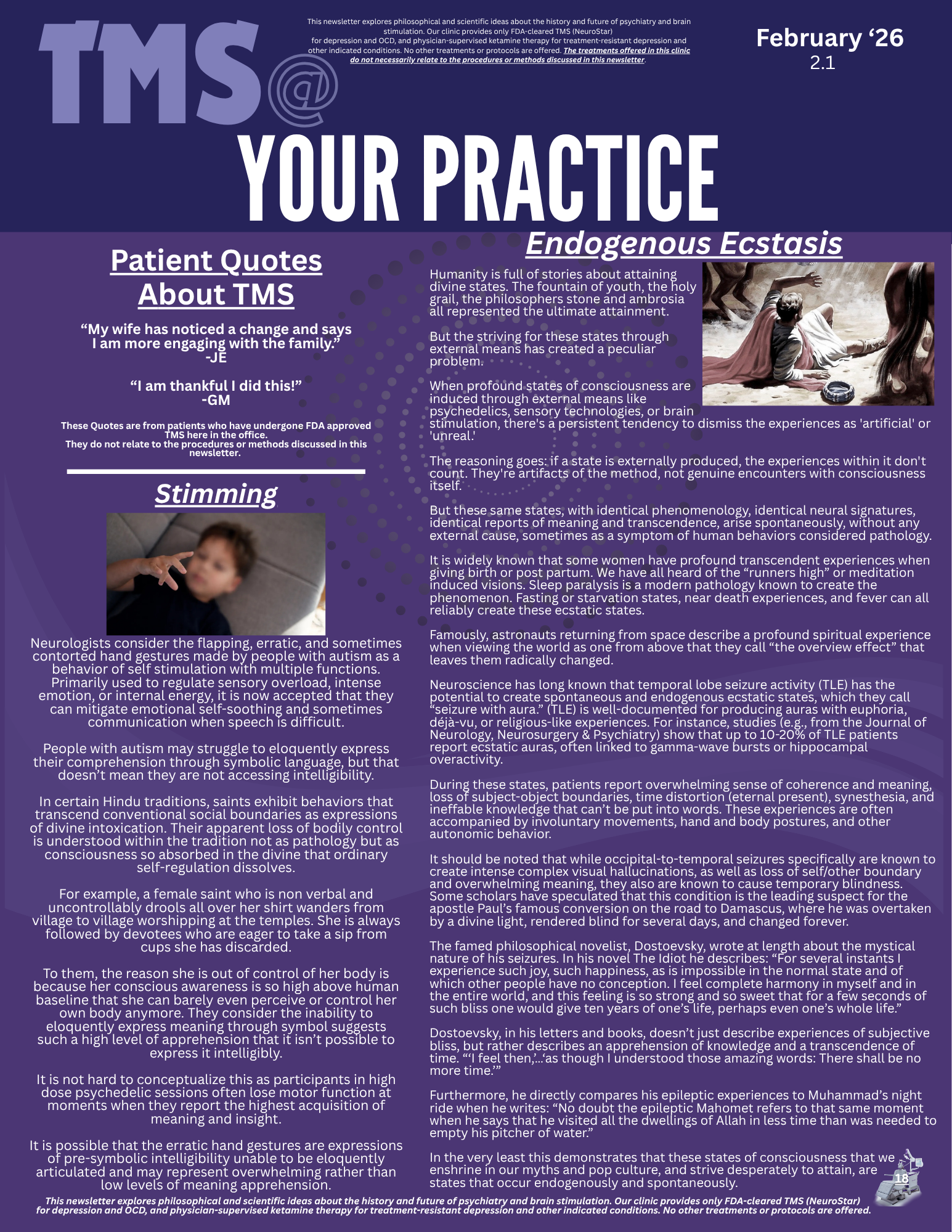
It should be noted that while occipital-to-temporal seizures specifically are known to create intense complex visual hallucinations, as well as loss of self/other boundary and overwhelming meaning, they also are known to cause temporary blindness. Some scholars have speculated that this condition is the leading suspect for the apostle Paul’s famous conversion on the road to Damascus, where he was overtaken by a divine light, rendered blind for several days, and changed forever.
The famed philosophical novelist, Dostoevsky, wrote at length about the mystical nature of his seizures. In his novel The Idiot he describes: “For several instants I experience such joy, such happiness, as is impossible in the normal state and of which other people have no conception. I feel complete harmony in myself and in the entire world, and this feeling is so strong and so sweet that for a few seconds of such bliss one would give ten years of one’s life, perhaps even one’s whole life.”
Dostoevsky, in his letters and books, doesn’t just describe experiences of subjective bliss, but rather describes an apprehension of knowledge and a transcendence of time. “’I feel then,’…’as though I understood those amazing words: There shall be no more time.’”
Furthermore, he directly compares his epileptic experiences to Muhammad’s night ride when he writes: “No doubt the epileptic Mahomet refers to that same moment when he says that he visited all the dwellings of Allah in less time than was needed to empty his pitcher of water.”
In the very least this demonstrates that these states of consciousness that we enshrine in our myths and pop culture, and strive desperately to attain, are states that occur endogenously and spontaneously.
Stimming
Neurologists consider the flapping, erratic, and sometimes contorted hand gestures made by people with autism as a behavior of self stimulation with multiple functions. Primarily used to regulate sensory overload, intense emotion, or internal energy, it is now accepted that they can mitigate emotional self-soothing and sometimes communication when speech is difficult.
People with autism may struggle to eloquently express their comprehension through symbolic language, but that doesn’t mean they are not accessing intelligibility.
In certain Hindu traditions, saints exhibit behaviors that transcend conventional social boundaries as expressions of divine intoxication. Their apparent loss of bodily control is understood within the tradition not as pathology but as consciousness so absorbed in the divine that ordinary self-regulation dissolves.
For example, a female saint who is non verbal and uncontrollably drools all over her shirt wanders from village to village worshipping at the temples. She is always followed by devotees who are eager to take a sip from cups she has discarded.
To them, the reason she is out of control of her body is because her conscious awareness is so high above human baseline that she can barely even perceive or control her own body anymore. They consider the inability to eloquently express meaning through symbol suggests such a high level of apprehension that it isn’t possible to express it intelligibly.
It is not hard to conceptualize this as participants in high dose psychedelic sessions often lose motor function at moments when they report the highest acquisition of meaning and insight.
It is possible that the erratic hand gestures are expressions of pre-symbolic intelligibility unable to be eloquently articulated and may represent overwhelming rather than low levels of meaning apprehension.